

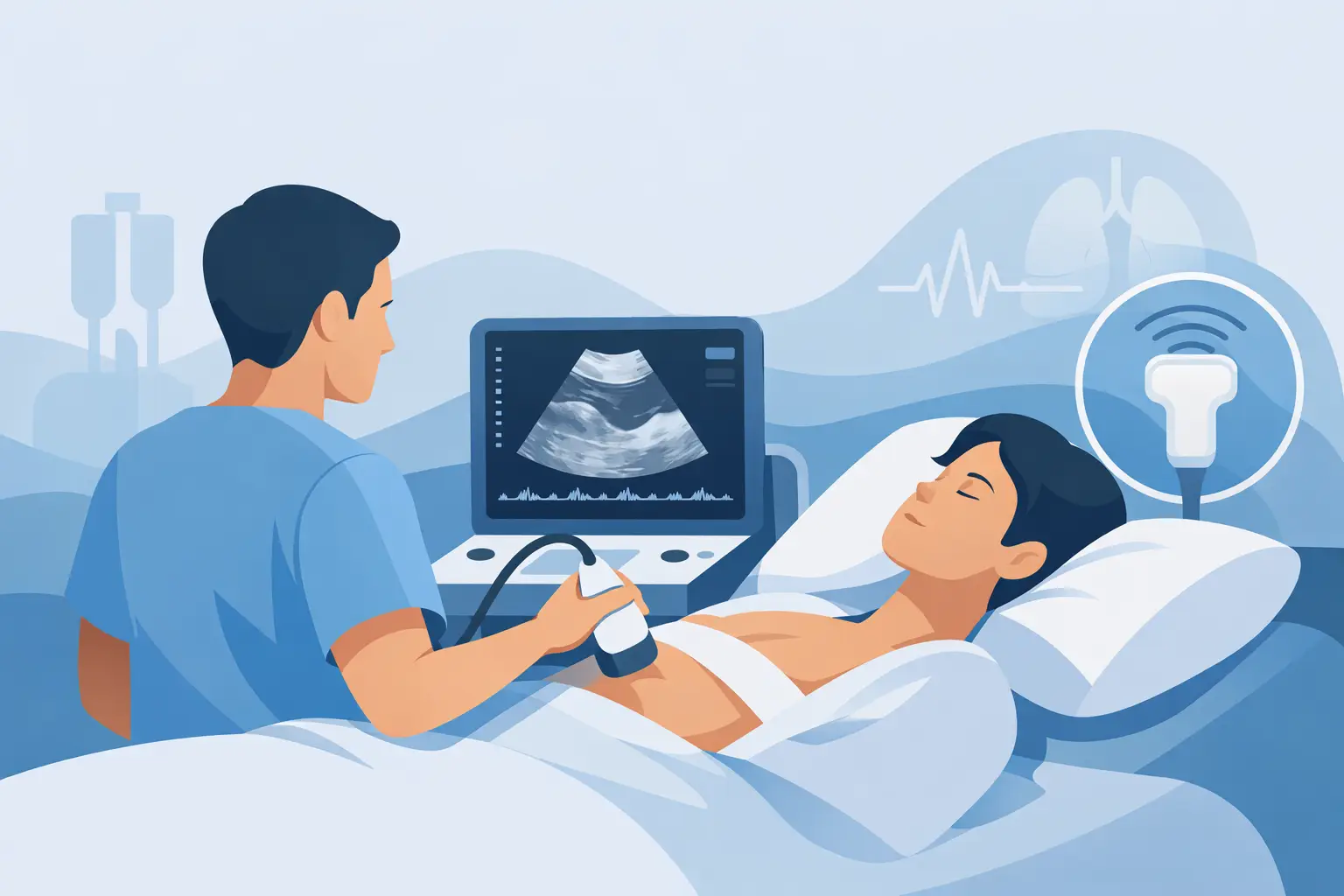
A new symptom can bring a lot of uncertainty. When a clinician can gather more information during the same office visit, patients may feel more informed about what is happening and what should come next. What is POCUS? POCUS stands for point-of-care ultrasound, a focused ultrasound exam performed by a trained clinician right where care is being provided.
Rather than sending every patient to a separate imaging center before learning more, POCUS can provide a real-time view of certain structures inside the body. It is one more tool that can support a thoughtful physical exam, a careful conversation, and a personalized care plan. It does not replace every type of imaging, but in the right situation, it can help answer practical clinical questions without unnecessary delay.
What Is POCUS and How Does It Work?
Point-of-care ultrasound uses a small handheld probe placed against the skin. The probe sends sound waves into the body and receives returning echoes, which are displayed as moving images on a screen. Unlike X-rays or CT scans, ultrasound does not use radiation.
The word “point-of-care” describes where and how the exam is used. It is performed at the time of evaluation and is usually focused on a specific question raised by a patient’s symptoms, medical history, or physical exam. For example, a clinician may use ultrasound to look for fluid, assess the appearance of the thyroid, view the bladder, or gain information about the heart and lungs.
A POCUS exam is different from a comprehensive diagnostic ultrasound performed by an imaging department. Comprehensive studies are often more detailed, follow standardized protocols, and may be interpreted by a radiologist or another specialist. POCUS is generally designed to add timely, clinically useful information during a visit. When a full study is needed, the POCUS findings can help guide the next step.
Why a Focused Ultrasound Can Be Helpful in Primary Care
Primary care is built on seeing the whole person, not simply reacting to one measurement or test result. A focused ultrasound can give your provider another perspective while they consider your symptoms, medications, medical conditions, and goals for care.
For some concerns, having this information available in the office may help clarify whether watchful follow-up is reasonable, whether laboratory testing or formal imaging is appropriate, or whether a referral should happen sooner. The benefit is not that ultrasound provides every answer. The benefit is that it can make the clinical conversation more informed.
POCUS may also be useful for ongoing health management. For patients with conditions that require regular monitoring, a clinician may use it alongside vital signs, laboratory results, and a physical exam to look for changes that deserve closer attention. The decision to use POCUS always depends on the concern being evaluated and whether ultrasound is likely to provide useful information.
Common Uses of POCUS
POCUS can support evaluation in several areas of outpatient care. A clinician may use it to assess the lungs when certain breathing symptoms are present, examine the bladder when urinary retention is a concern, or look at soft tissue changes such as swelling or a lump near the skin’s surface.
It may also help evaluate the thyroid, abdomen, blood vessels, heart, or joints in selected situations. For example, ultrasound can sometimes help distinguish fluid from solid tissue or help determine whether a visible area needs more detailed testing. Because it creates live images, it can also assist clinicians during certain in-office procedures by helping them identify the area of interest more precisely.
These uses are not interchangeable, and ultrasound has limits depending on the part of the body being examined. Gas in the intestines, body tissue, the position of an organ, and the quality of the available view can all affect what can be seen. A normal POCUS exam does not always rule out every possible condition, particularly when symptoms are concerning or persistent.
What a POCUS Visit Feels Like
For most patients, POCUS is simple and comfortable. Your clinician will explain why the exam may be helpful and which area they would like to assess. A small amount of clear gel is placed on the skin to help the probe make good contact. The probe is then moved gently across the area being examined.
There are no injections, radiation exposure, or recovery time associated with the ultrasound itself. Many focused exams take only a few minutes, although the overall appointment may take longer because your provider is evaluating the full clinical picture. You may be asked to change position, take a deep breath, or hold your breath briefly so the images are clearer.
One of the most meaningful aspects of POCUS is that it supports conversation in real time. Your provider can explain what they are assessing and how the findings fit with your symptoms. Still, clinicians should avoid making assumptions from one image alone. A responsible interpretation considers the entire visit, including your history, exam, prior records, and any needed follow-up testing.
What POCUS Can and Cannot Tell Your Provider
POCUS is powerful because it is immediate and focused, not because it replaces all other medical evaluation. It can help identify findings that may explain symptoms, make some concerns less likely, and determine whether additional care is needed. It can also help a clinician recognize when a patient should have a formal ultrasound, other imaging, laboratory testing, specialist evaluation, or urgent treatment.
At the same time, a POCUS exam may not provide enough detail to diagnose a complex condition. Some structures are difficult to visualize, and certain health concerns require specialized imaging protocols or expert interpretation. If your clinician recommends additional testing after POCUS, that does not mean the exam was unsuccessful. It often means the focused scan helped identify the safest and most appropriate path forward.
The value of POCUS also depends on the clinician’s training, the clinical question, and the quality of the images obtained. Patients should feel comfortable asking why an ultrasound is being used, what the provider is looking for, and what the result means for their care plan.
When to Ask About Point-of-Care Ultrasound
You do not need to know in advance whether POCUS is appropriate for your appointment. That is a decision your provider can make after listening to your concerns and performing an exam. However, it can be reasonable to ask whether a focused ultrasound might help when you have a symptom that needs further clarification or when you are discussing follow-up for a known concern.
At Ekom Medical, the goal is not to order more tests than you need. It is to use the right tools at the right time, while ensuring you understand your options and feel heard throughout the process. POCUS can be especially valuable when it helps turn a vague concern into a clearer next step.
If you are experiencing severe symptoms, sudden difficulty breathing, fainting, significant weakness, or other symptoms that feel urgent, seek emergency care rather than waiting for an office ultrasound. POCUS is a helpful outpatient tool, but urgent situations require prompt evaluation in the appropriate setting.
A good medical visit should leave you with more than a test result. It should leave you with a clearer understanding of what your provider sees, what remains uncertain, and how you will move forward together.

Comments are closed